
Timmy
Demonstrating an advanced approach to human-animal coexistence and canine psychology.
FAQ
Frequently Asked Questions
Is Timmy allowed to enter establishments in Portugal?
Portuguese law recognizes dogs as sentient beings with specific rights and protection. Due to his medical necessity to be under supervision at all time, refusal of access to Timmy must be based on specific factors such as:
- Aggressive or disruptive behavior
- Lack of hygiene
- Proven disruption to the normal functioning of the establishment
These factors can only be assessed if the animal is physically present and causing a problem.
Why must Timmy stay with his owner?
Timmy has epilepsy, a serious and incurable neurological disease. His condition is managed under veterinary supervision, and his environment, stress levels, and emotional state must be carefully regulated to reduce seizure risk.
Timmy must remain with his owner not only so seizures can be recognized and managed immediately, but also because separation, loss of perceived safety, or acute stress can themselves act as seizure triggers.
A seizure is a serious medical event that can lead to permanent brain damage or death. For this reason, Timmy’s continuous proximity to his owner is part of his medical risk management, not a matter of convenience or preference.
How did you train Timmy to be so calm and well behaved?
Timmy is stable and well behaved because he receives continuous education, mental stimulation, and lives in a stable environment.
Dogs that are treated like disposable objects, left without structure, stimulation, or respect often develop behavioral problems such as excessive barking, destruction, anxiety, or aggression.
Timmy’s behavior is the result of long-term responsibility, work and respectful environments.
Why can't Timmy become an assistant dog?
Timmy has epilepsy, which is a serious neurological condition.
Assistant dogs must pass physical and stress-resistance tests that require sustained activity, exposure to unpredictable environments, and long working periods.
Due to his epilepsy, sustained physical activity, high stimulation, or certain stressful environments can trigger seizures.
For this reason, attempting to pass assistant dog physical tests would represent a medical risk for him.
In other words, the very tests required to become an assistant dog are not compatible with his medical condition.
Are dogs a health or safety risk in shared spaces?
Behaviorally stable and socially adapted dogs do not pose a health or safety risk to the people and animals around them. On the contrary, many risks commonly associated with dogs emerge from fear, overstimulation, chronic restraint, poor socialization and disconnection from natural environmental learning.
Responsible guardians also monitor their dog and remove them if they become uncomfortable or disruptive.
Research also shows that the presence of dogs have measurable benefits for human wellbeing and social interaction and positively influence mental and emotional health. They can contribute to reduced stress, improved mood, and increased social connection among people.
You can explore some of the scientific literature here: what the science say
While Timmy is an inoffensive dog with epilepsy condition, some people interact with him in inappropriate manners that can turn to be dangerous for him:
- approaching suddenly, making loud noises, barking at him (yes you read that well)
- touching the dog roughly, shaking his head, slapping him
- attempting to pick the dog up without permission
- moving abruptly around the dog and startling them on purpose
What is a behaviorally stable and socially adapted dog?
A behaviorally stable and socially adapted dog refers to an animal capable of calm, non-reactive and environmentally aware coexistence with humans and other animals without relying on chronic physical restraint or coercion.
Such dogs naturally avoid unnecessary conflict, voluntarily remain close to their human, adapt to changing environments, remain quiet, and do not display disruptive, fearful or aggressive behaviors in social situations.
This does not describe superficial obedience based on force, fear or constant command repetition. It refers to emotional regulation, trust, observation, adaptation and voluntary cooperation developed through real-world coexistence and social learning.
Why is non-verbal communication important?
A healthy human-animal partnership progressively develops quiet and observational forms of communication. Dogs naturally pay attention to posture, gestures, facial expressions, movement and emotional state.
Loud commands, repeated shouting, sudden corrections, emotional tension or aggressive reactions from owners create stress and overstimulation not only for the dog, but also for the people and animals sharing the same environment.
With Timmy, most interactions happen silently. A simple gesture, posture change or facial expression is often enough for him to understand what to do.
What if the dog barks during a gathering?
Well-socialized and educated dogs typically spend most of their time resting quietly beside their guardian.
Responsible dog guardians monitor their animals and remove them if they become disruptive, like a parent would do with a crying baby. In practice, Timmy remain less disruptive than many everyday noises present in shared environments, people do not necessarily notice he is there.
Some humans have barked at Timmy, not the opposite (yes, you read that well).
What about people who are afraid of dogs?
Fear of dogs is real and should be respected.
At the same time, the presence of a calm and controlled dog does not require interaction. Just as with many other everyday situations, people can simply keep distance if they prefer.
Well-trained dogs that remain with their handler do not impose contact on others.
What about limited space?
Dogs that stay close to their guardian typically occupy very little space. Many simply lie down quietly next to a chair or table.
Timmy effectively takes less physical space than a backpack and prefer to rest on my laps most of the time.
As long as walkways and exits remain clear, space constraints are not a practical issue.
What about allergies?
Dog allergies exist and should be taken seriously.
However, brief presence of a dog in a shared indoor space rarely triggers severe reactions, sensitivity to animals can vary over time, and some people become less reactive with age or through medical treatment.
We have extensive experience managing situations involving dog allergies. These situations have always been handled calmly and practically with the people directly concerned. This is not a new or unusual situation, and it does not require assumptions or third-party intervention. When someone has an allergy, simple and respectful arrangements are usually enough.
Research has also shown that early and regular exposure to dogs help reduce the likelihood of developing certain allergies, particularly in childhood.
Does Timmy bite?
No. Timmy is a small, calm, and well-socialized companion dog with a medical condition that makes him defenceless.
He regularly interacts with people in a relaxed way, including gentle encounters with children who pet him. Timmy has consistently shown a gentle and friendly temperament, and as any responsible dog guardian, I always supervise these interactions to make sure they remain comfortable and safe for everyone involved.
There has never been any incident where Timmy has bitten or attempted to bite anyone.
Many people who meet Timmy are surprised by how calm, affectionate and well-behaved he is.
I didn't know a dog could be epileptic.
Any animal with legs can experience leg pain — so why would it be any different with the brain? Dogs are mammals, just like us. In fact, humans and dogs share about 84% of their DNA. Timmy’s treatment uses the same molecule prescribed to humans with epilepsy — the only difference is the dosage, which is adjusted for a dog’s weight. Even the emergency medication used during his seizures is originally formulated for humans and bought directly from the pharmacy.
How do you know that a seizure may happen soon?
Epilepsy is a real and serious neurological condition. Even with treatment, seizures can still happen throughout the animal’s life. Medication usually aims to reduce the frequency, intensity or unpredictability of seizures, not necessarily eliminate them completely.
After living with Timmy’s condition for a long time, I progressively learned to recognize certain patterns, behaviors and periods where a seizure may become more likely. This does not mean a seizure is guaranteed, but rather that experience sometimes allows subtle changes to be noticed before it happens.
This awareness is not pessimism. It is simply part of adapting to a chronic condition with observation, patience and care.
During these periods, I usually try to maintain a calm and low-stimulation environment around Timmy.
If we allow to bring your dog in, everyone else will bring their dogs and it will be a mess.
That statement reflects a bias, not a fact. Assuming trouble in advance unfairly penalizes responsible dog owners and ignores the principle of presumption of innocence.
Most dog owners are very aware of their dog’s behavior and won’t bring them into spaces where they might cause disruption. Well-socialized and balanced dogs don’t create chaos — they coexist peacefully. There’s no evidence to suggest that allowing one responsible dog would suddenly lead to disorder.
And if more well-behaved dogs did come, it would only add to the many well-documented health and social benefits that dogs bring to communities — something to welcome, not fear. For those who prefer not to interact, that’s entirely fine too, he’s probably ignoring you anyway. Mutual respect and peaceful coexistence go both ways.
“If we let your dog in, everyone will bring theirs and it’ll be chaos!”, that’s like saying “if we let one kid into the library, suddenly it’s a daycare.”
What value does Timmy bring to communities?
Calm, educated dogs have positive effects on humans. Interaction with dogs is known to reduce stress and trigger positive hormonal responses such as oxytocin release.
However, these positive effects only exist because the dog is stable, educated, and feels safe. That stability depends on a respectful and consistent environment.
Treating a dog as a disposable object while enjoying the benefits of interacting with him undermines the conditions that make those positive effects possible.
Why should leash use remain exceptional rather than permanent?
Leash use should remain a temporary and situational tool rather than the foundation of healthy human-animal coexistence.
Multiple observations led to the conclusion that chronic leash use can limit autonomy, environmental awareness and the development of socially responsible behavior in dogs. Many forms of voluntary cooperation appear to emerge naturally when dogs are progressively allowed to observe, adapt and make decisions within real-world environments.
Leashes can also introduce risks for both dogs and humans, including choking, entanglement, panic reactions or accidental trip hazards in situations such as:
- a child suddenly grabbing the dog,
- another dog attacking,
- a seizure,
- a loud noise triggering panic,
- a pain causing an unexpected reaction.
Temporary restraint may sometimes remain useful in specific or transitional situations, especially for unstable, fearful or poorly socialized dogs, but should not replace long-term behavioral development.
Are crowds a stress factor for Timmy?
No. As documented publicly, crowds are not a stress factor for Timmy.
However, certain environments, particularly environments where other dogs are present (even at a distance), due to past trauma, represent a significantly higher seizure risk.
Stress triggers are medical matters and are evaluated based on observation and veterinary guidance, not assumptions.
Who decides what is a stress factor for Timmy?
Decisions regarding Timmy’s stress factors, environment, and daily management are made under veterinary guidance. His owner is the person legally and medically responsible for him, these decisions fall under their sole responsibility and authority, not external opinion.
Testimonial
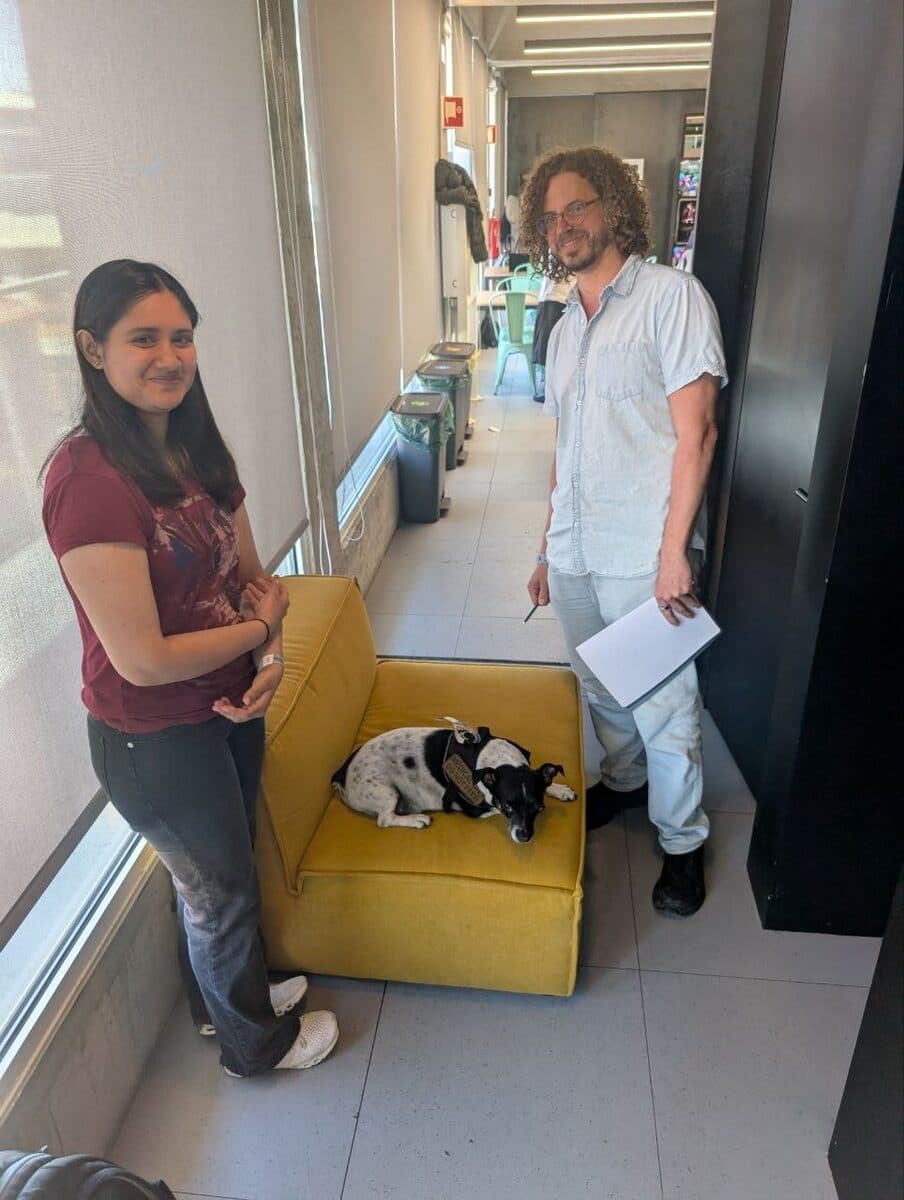
“Timmy was the muse and inspiration for our project because he’s adorable and was the representative of our team ❤️”
Learn more

Health benefits of dogs for humans.
Dogs heal people. They calm children, reduce loneliness, help prevent panic attacks, guide the blind, and so much more.
The Story of Timmy.
Rescued while already living with epilepsy, Timmy demonstrates resilience and an advanced approach to human-animal coexistence